System observation notes after watching Mediastorm's "With 1 Million, We Uncovered the Casino's Secrets". I am skipping the moral question about gambling and focusing on one structural prompt: when an industry has to depend on "a large mass of players losing money over the long run" to stay stable, how is that system engineered?
A casino is systems engineering that binds math, psychology, architecture, and social structure into one piece. The part worth noticing first: how quiet it is.
# The House Does Not Need to Win Every Hand
Intuition says casinos want customers to lose huge and get walked out — wrong picture. Their business model wants you to win often: small wins, frequent wins, wins that convince you today is a lucky day. Only "occasional wins" keep people at the table. As long as people stay seated, time and math are on the house's side.
The house is hunting a long-term, statistical, almost mechanical kind of boring victory. The outcome of any single hand is noise. The only variable that matters is sample size.
# Those Two Green Slots Are the Whole System
American roulette has 18 red, 18 black, and two green slots: 0 and 00.
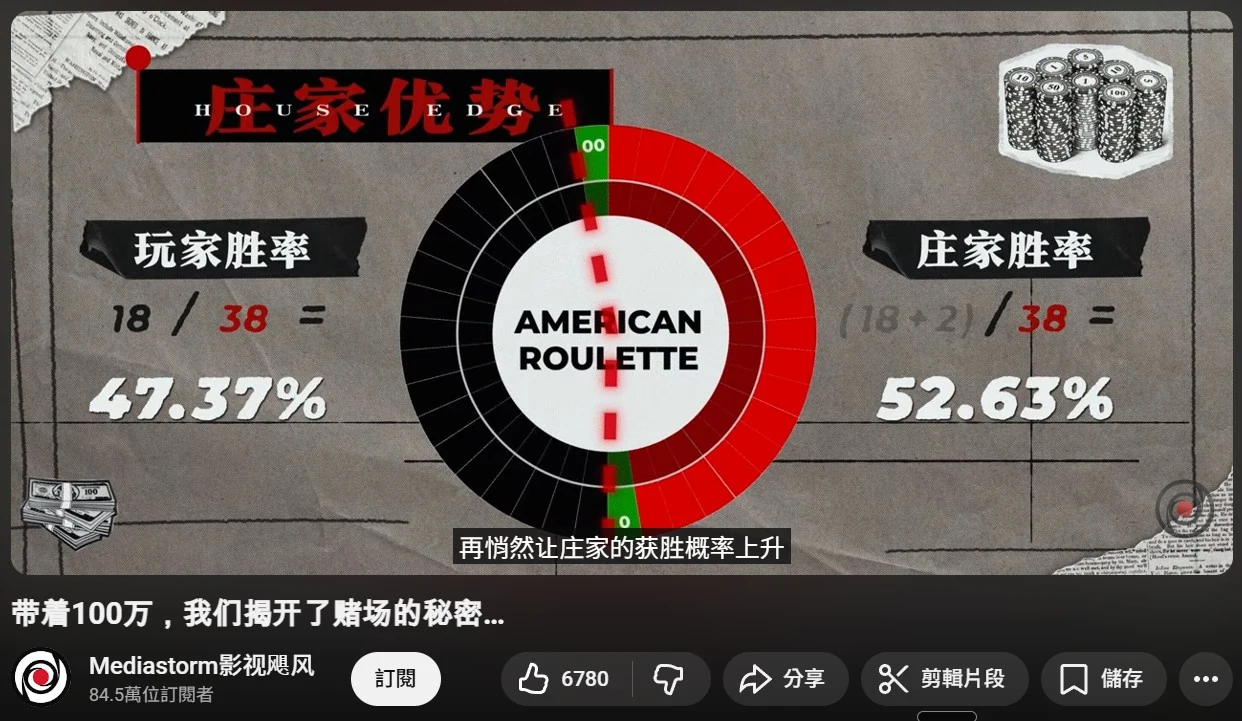
Betting a single color wins at 18/38 ≈ 47.37%; the house wins at 20/38 ≈ 52.63%. The 5.26% gap is the House Edge. The law of large numbers guarantees: the more bets are placed, the more that tiny bias scales into an irreversible outcome.
Slot machines run the same logic in a different wrapper. RTP (return to player) is usually set at 85–95%, which means every 100 units in, the mathematical expectation is a stable loss of 5–15 units. Each spin is decided by an independent RNG; the machine has no memory of "being due for a jackpot."
# Even Dealers at the Table Do Not Win More
Off-duty dealers win at the same rate as tourists. A nontrivial number of dealers cycle their day's wages back into the tables. The math knowledge does not protect them.
The house edge comes from a structural gap — it lives in the rules themselves, independent of whether you can count cards. Understanding a system and not getting crushed by it are two separate things: the first sits in the cognitive layer, the second depends only on whether you sit down. The moment a dealer sits down, they degrade into a statistical sample.
# "House Money" — Sharper Than the Math
The math layer is relatively plain. The real precision lives in the psychological layer stacked on top. Behavioral economics calls it the "House Money Effect": when a player wins a chunk of cash by chance, the brain auto-classifies that profit as "the casino's money," not "personal hard-earned income."
Once that mental ledger is set up, risk appetite shifts up: bet sizes grow, decision frequency speeds up, loss sensitivity drops. That is exactly the target state for the house. Free alcohol, scented air, no clocks, no windows, low-volatility slots placed near the entrance — every piece pushes the player toward that state.
This design pattern lives in more than one industry. On the surface the user is choosing; underneath, the environment has already compressed the choices into a very narrow band.
-
Layer 1: Math
House edge baked into the rules — long-run harvest, no luck required. -
Layer 2: Psychology
House Money Effect, sunk cost, time-perception strip — players push chips forward on their own. -
Layer 3: Architecture and Senses
No windows, no clocks, constant temperature and lighting, scented air — every exit cue removed.
# Profit Privatized, Cost Socialized


The casino itself does not lend money to a player on the edge of bankruptcy. The streets around it are stacked with loan sharks running annual interest above 300%. The division of labor is clean: the casino collects cash flow, the loan shark collects houses and cars as collateral.
The whole industry runs as an ecosystem — casinos, loan sharks, senior bus tours, pawn shops, free meal coupons. Each piece owns one stage of the funnel and owns only its own slice. It is a system with responsibility sliced thin: no single node is on the hook for the final outcome.
At a larger scale, casinos and governments split the hundred-billion-class profits and tax revenue. Addiction, depression, broken families, rising crime rates — all those costs get externalized to society. Standard economics: when benefits are private and costs are social, the activity inevitably gets overproduced. The casino industry is the textbook example.
# Nobody Pays for the Crushed Lives
In the storm drain tunnels under Las Vegas live the residual samples of the system: bankrupt gamblers, former low-level workers from the strip. They never appear in casino annual reports, city promo videos, or any "industry contribution to GDP" stat sheet.
That is the output of structural design — no node in the system is required to be responsible for them, rather than a simple information blind spot. The system's core feature is not how much money it can win. It is the manner of winning: every upstream profit node can cleanly forward the bill downstream.
Profit concentrated, risk dispersed, cost reframed as "unfortunate individual cases" — similar patterns show up across many fields. Casinos just execute the logic most transparently, with the least cosmetic cover.
# The Only Winning Strategy
Facing a system armored by math and psychology together, the only strategy that guarantees a win is never sitting down at the table.
Once the system structure is tilted against the player, every "beat it from inside" strategy — card counting, bet sizing, stop-loss discipline, so-called sure-win formulas — is just slowing down how fast you lose, not changing the direction of the loss.
The move that actually works is refusing to enter. In a game with unfavorable rules, "not playing" is the strongest move available.
When a system runs against you, the most effective action is choosing not to enter — clearly. Trying harder inside it does not move the outcome.
Source
Reflections based on Mediastorm:
"With 1 Million, We Uncovered the Casino's Secrets..."