Simon Sinek has two talks that get shared a lot. The first is an 18-minute TED talk that introduces the Golden Circle: leaders and organizations that people follow all start with Why when they speak. The second runs only 3 minutes 46 seconds and covers the step after a promotion: the thing you are responsible for changes from "the job" to "the people who do the job." This post lays out the argument of both talks as they were given. Both end up at the same place — people follow someone for the sake of what they themselves believe.
# Same Conditions, Different Results
The first video opens with three questions. Apple has access to roughly the same talent, agencies, consultants and media as its peers. Why is it more innovative year after year? Many people suffered in pre-civil-rights America, and there were many great orators. Why was Martin Luther King the one who led the movement? Several teams had more money and better qualifications. Why were the Wright brothers the first to achieve powered man flight?
Sinek then sets the Wright brothers against their contemporary, Samuel Pierpont Langley:
- LangleyGiven $50,000 by the War Department; held a seat at Harvard and worked at the Smithsonian, extremely well connected; The New York Times followed him everywhere.
- WrightsPaid for the research with proceeds from their bicycle shop; not a single person on the team had a college education, Orville and Wilbur included; The New York Times followed them nowhere.
If money, people and market conditions are the usual recipe for success, Langley had all three. Sinek puts the real difference in motivation: the Wright brothers believed that figuring out this flying machine would change the course of the world; Langley wanted to be rich and famous.
On December 17, 1903, the Wright brothers took flight. Almost no one was there, and the news came out a few days later. Langley quit on the day the Wright brothers flew. Sinek's reading is blunt: he wasn't first, he didn't get rich or famous, so he stopped.
# The Golden Circle: The Order of Information
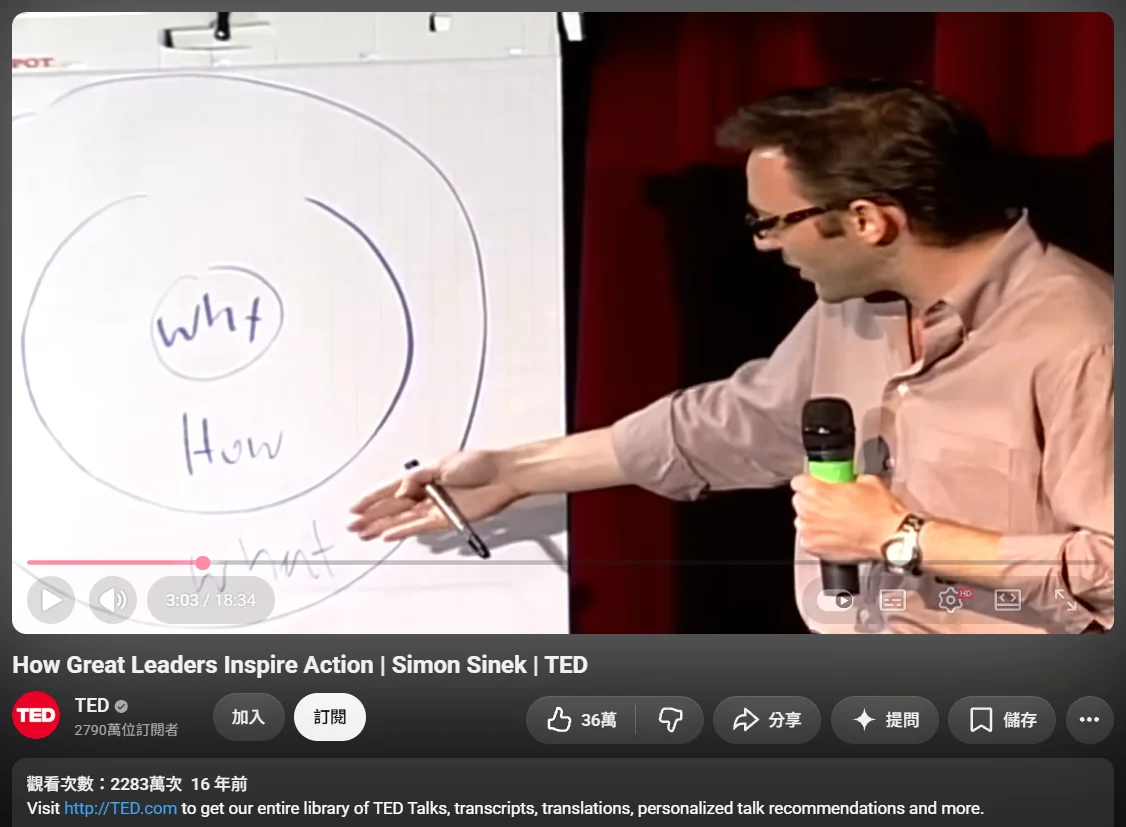
Sinek calls this pattern "the Golden Circle," with three layers from the outside in:
- WhatWhat you do. Every person and every organization knows this 100%.
- HowHow you do it. The differentiating value proposition, the proprietary process, the USP. Some organizations know this.
- WhyWhy you do it. The purpose, the cause, the belief, and why the organization exists. In Sinek's definition, making money is a result, and he places it outside of Why.
Most people communicate from the outside in: they start with the clearest thing, What, move on to How, and only reach the fuzziest thing, Why, at the end. The leaders and organizations he studied work the other way: regardless of size or industry, they think, act and communicate from the inside out.
He uses Apple to demonstrate. The two versions of the message carry essentially the same product information; only the order changes:
- Outside in"We make great computers. They're beautifully designed, simple to use, and user-friendly. Want to buy one?"
- Inside out"Everything we do, we believe in challenging the status quo. We believe in thinking differently. The way we challenge the status quo is by making our products beautifully designed, simple to use, and user-friendly. We just happen to make great computers. Want to buy one?"
Then comes the most quoted line of the talk: "People don't buy what you do, they buy why you do it."
Sinek backs it up with two computer companies. Gateway had made flat-screen monitors for years, launched flat-screen TVs, and they didn't sell; Dell launched MP3 players and PDAs, well made and well designed, and they didn't sell either. Apple went from computers to MP3 players, phones and DVRs, and people kept buying.
Sinek then maps the Golden Circle onto the brain. He matches the neocortex to What, describing it as responsible for rational, analytical thought and language; the middle two sections match How and Why, responsible for feelings like trust and loyalty, as well as behavior and decision-making. He uses this mapping to explain a common situation — "I know what all the facts say, but it just doesn't feel right." The part of the brain that makes the decision cannot put its judgment into language, so the best it can do is call it a "feeling." This part is Sinek's own explanation in the talk; the talk does not cite a research source for it.
# Why Find People Who Believe the Same Thing
Sinek then turns the goal toward people. The business to do is with people who believe what you believe; the people to hire are also people who believe what you believe. People hired only because they can do the job work for your money; people who believe what you believe may work for you with blood, sweat and tears.
Here he borrows the law of diffusion of innovations:
- 2.5%Innovators
- 13.5%Early adopters
- 34%Early majority, followed by the late majority and the laggards
- 15–18%Tipping point: at around this market penetration, the system starts to tip into the mass market
The early majority usually needs to see someone else try something first before following. Innovators and early adopters lean on their intuition and their view of the world when deciding. The people who stood in line for six hours for the first iPhone, and the people who paid $40,000 for a flat-screen TV when they first came out, are the ones Sinek puts in this group. In his words, what they bought was being first. The gap from about 10% to 15–18% is what he calls, borrowing Moore's term, "crossing the chasm."
The failure case is TiVo. Sinek describes it as the highest-quality product on the market at the time, well funded, with good market conditions, but at launch it talked only about features: pauses live TV, skips commercials, rewinds live TV, memorizes your viewing habits. At the IPO the stock was around $30–40, then it fell and never traded above $10 again. Sinek offers another way to say it: "If you're the kind of person who likes to have total control over every aspect of your life, boy, do we have a product for you." The features that follow stay word for word the same.
The success case is the summer of 1963. 250,000 people showed up in Washington to hear Dr. King speak. There were no invitations, and no website to check the date. What Dr. King kept saying was "I believe." People who believed the same thing made his cause their own and told others.
Sinek asks: how many of them showed up for him? His answer: zero. They came for what they believed about America, and about 25% of the audience was white. The speech was called "I Have a Dream." Sinek sets it against the 12-point plans common among politicians today: Dr. King spoke about "what I believe," and the 12-point plans speak about "what I will do for you."
# Inside the Company: The Moment of Promotion
The second video covers the same idea inside an organization. Sinek opens by saying great leaders need two things: empathy and perspective. The real job of a leader is "taking care of those in our charge."
Early in a career there is one responsibility: be good at your job. The company teaches you the software, sends you away for a few days of training, and if you're good, you get promoted. At some point the promotion puts you in charge of "the people who do the job you used to do." Nobody teaches this part.
Sinek's explanation of micromanagement is direct: managers really do know how to do the job better than their reports, and that is exactly what got them promoted. The catch is that after the promotion, the responsibility has moved from "doing the job well" to "making sure the people who do the job can do it well." Some people make the transition quickly, some slowly, and some never really make it at all.
He treats leadership as a skill you can learn and practice, like a muscle: practice every day and it gets strong; stop and it gets weak. He also compares leadership to parenting. Everyone has the capacity, but whether you want to, or should, is another matter, because the cost is personal sacrifice. When things go right, you give away all the credit; when things go wrong, you take all the responsibility. You stay late to show someone what to do; when something breaks, instead of yelling or taking over, you say one thing: "Try again."
He ends with CEOs. Ask a CEO what their priority is, and they may answer: "The customer." Sinek's reply: you haven't talked to a customer in 15 years. A CEO is responsible for a group of people, who are responsible for another group, who are responsible for the customer. So the people a CEO actually has to take care of are the ones responsible for serving the customer.
# Where the Two Talks Meet
One is about communicating outward, the other about leading people. On the surface they are two different topics, and they end up at the same distinction. At the end of the TED talk, Sinek separates leaders from those who lead: the former may hold power or authority; the latter inspire us, whether they are individuals or organizations.
The second video moves that line into the company. A promotion gives you a position; the work that really gets added after it is taking care of the people doing the work.
The mechanism the two talks share comes down to following. Sinek closes the TED talk with: "We follow those who lead not because we have to but because we want to. We follow those who lead not for them, but for ourselves."
# About Simon Sinek
His TED speaker page describes him as exploring how leaders can inspire cooperation, trust and change, and as the author of best-selling books including Start With Why, Leaders Eat Last, Together is Better and The Infinite Game. His personal website also lists Find Your WHY and calls him "an unshakeable optimist."
Beyond writing, he founded The Optimism Company, a leadership learning and development company; hosts the podcast A Bit of Optimism; publishes other thinkers through Optimism Press, a partnership with Penguin Random House; and is an adjunct staff member at the RAND Corporation.
He is best known for his TED talk on WHY. His website currently lists it as viewed over 60 million times.
# Links
- • Video 1: How Great Leaders Inspire Action (Chinese subtitles) (天下雜誌 Video, 18:02)
- • Video 2: Why Most Managers Aren't Fit to Lead (Chinese/English subtitles) (Wisdom Bread, 3:46)
- • Bio sources: TED speaker page, Simon Sinek's website (verified 2026-10-25)