Information overload, dense social graphs. How do I build a survival strategy with a positive long-run expected value?
I started thinking about this while watching digital communities die. Most of them eventually go quiet. The driver: individuals hiding real intent to avoid risk (the lurker behavior). Once a system only consumes information and produces nothing back, thermodynamics takes over. The system drifts into disorder and ends in heat death.
# Game Theory and Trust Evolution
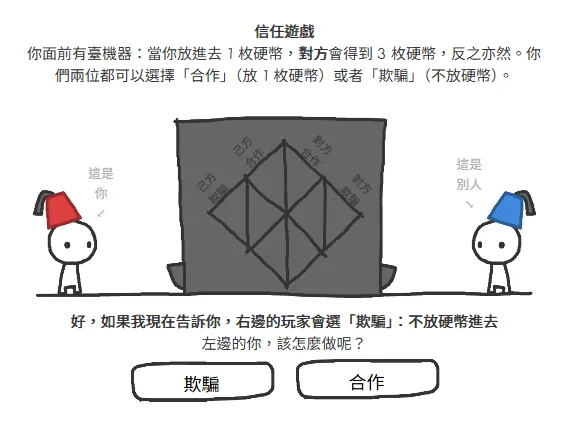
Trust is a dynamic game. Game theory frames it well. The classic interactive model The Evolution of Trust abstracts human interaction into the Iterated Prisoner's Dilemma, and from there you can derive the actual mathematical floor that trust is built on.
# The Optimal Strategy: Tit for Tat
Computer simulations of the iterated prisoner's dilemma show one strategy with the highest long-run payoff. The algorithm is brutally simple:
# Strategy logic:

1. Initial state:
   Cooperate. With no prior data, assume the other side is a good-faith node.

2. Reciprocity:
   Mirror the opponent's last move.
   (If they defect, trigger defense. If they cooperate, keep cooperating.)

3. Forgiveness:
   If the opponent switches back to cooperation, drop the defense immediately
   and resume cooperation. Avoids spiraling into infinite revenge.
The power of this strategy is in its memorylessness and determinism. The deterministic counter-punch blocks one-sided exploitation. The forgiveness gate maximizes the long-run cooperation dividend in any non-zero-sum game.
# Environment and the Zero-Sum Drift
The data shows high-quality connections in modern social graphs are dropping fast. The core reason: repeated interactions are getting rarer, so the cost of building long-term trust mechanisms is climbing steeply.
On top of that, the cultural frame is sliding toward zero-sum thinking:
- Zero-sum frame: the individual treats system resources as fixed, and assumes their gain has to come from someone else's loss.
- Non-zero-sum frame: cooperation creates new value in the system. This is the environment parameter required for trust mechanisms to propagate at scale.
# How System Noise Breaks Strategy Stability
Information transmission always carries noise. Call it misunderstanding. Three strategies to compare:
- Copycat: start cooperating, then mirror the opponent's last move. One defection triggers immediate retaliation. No forgiveness window. A single misunderstanding starts a mutual revenge loop.
- Copykitten: mirror the last move, but only defect after two consecutive defections. One misread gets a free pass. Built-in tolerance.
- Always Cheat: defects no matter what. Exploits cooperators in the short run, builds no trust network in the long run.
The winner shifts with the noise level:
- 0% noiseCopycat takes the global optimum.
- 1%-9% noiseCopykitten wins. Small amounts of noise push the system toward higher tolerance.
- 10%+ noiseSystem collapse. Always Cheat dominates.
The takeaway: moderate noise breeds more resilient forgiveness mechanisms; overload destroys the trust network entirely.
Conclusion
Core lesson from game theory: the rules of the game shape player behavior. Rules can be read, and they can be chosen.
At the micro level, environment parameters constrain individual strategy. At the macro level, the aggregate behavior of individuals is the core variable that builds the environment itself.
The long-run best practice: actively construct networks with repeated-interaction properties, keep information transmission precise to lower system noise, and hold the line on reciprocity plus measured forgiveness.